


Nerve Restore™ – What 60 Years Of Clinical Rehab Science Can Now Do For You At Home In 15 Minutes
Nerve Restore™ – What 60 Years Of Clinical Rehab Science Can Now Do For You At Home In 15 Minutes
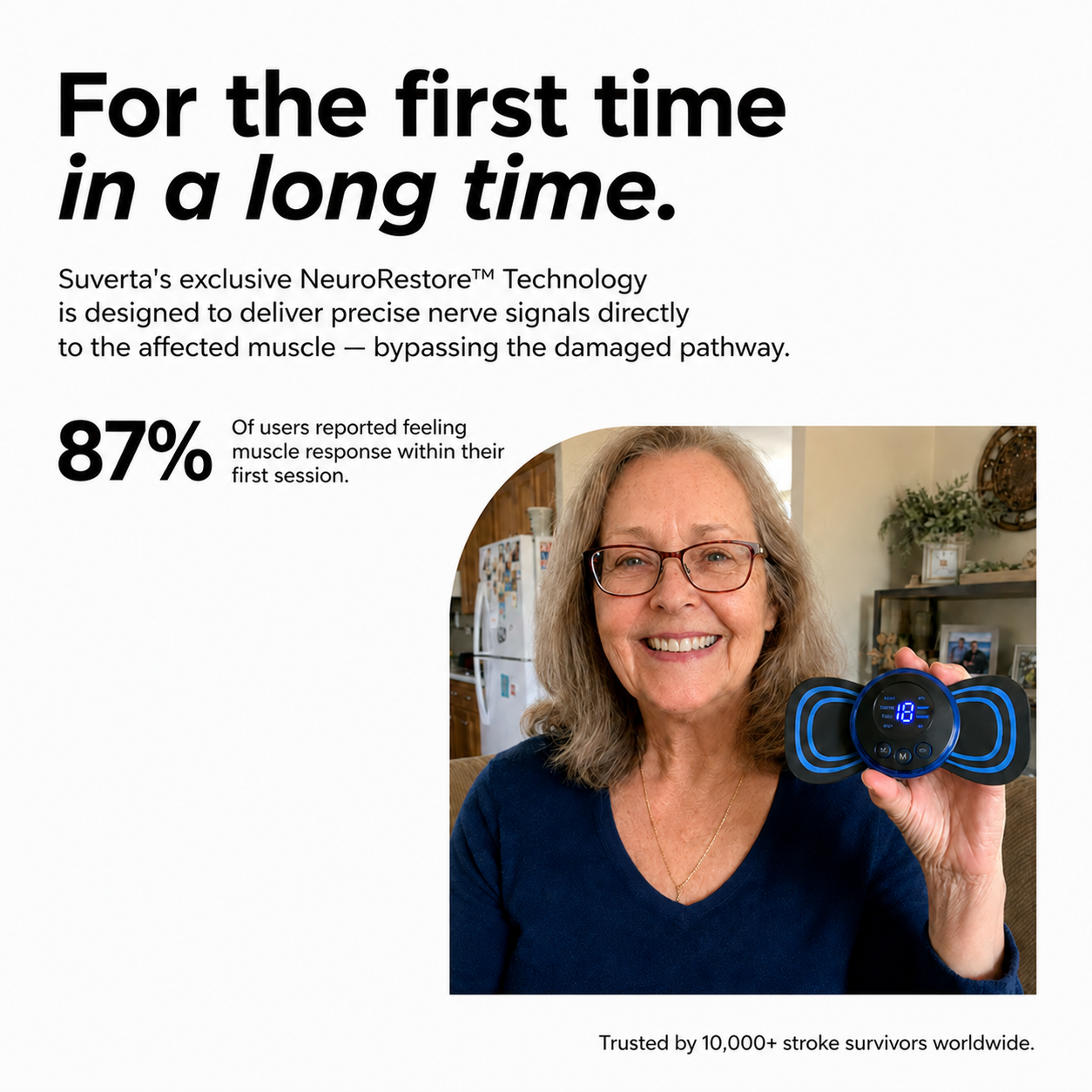
Gentle electrical pulses delivered directly to the affected muscle. Bypassing the damaged pathway. Restoring what was lost.
Targets motor nerves, not pain
Clinical-grade stimulation at home
Single-handed setup, no assistance needed
NeuroRestore Technology™
Feel a muscle response from session one
Bundle & Save
Couldn't load pickup availability

Nerve Restore™ – What 60 Years Of Clinical Rehab Science Can Now Do For You At Home In 15 Minutes
30-Day Guarantee
Free Shipping

What's Included
What's Included
1× Nerve Restore Device — The core unit. Delivers precisely calibrated neuromuscular stimulation with 8 modes and 19 intensity settings, built to adapt to every stage of recovery.
2× Electrode Pads — Medical-grade gel pads that adhere firmly to the skin without tape or straps. Designed for single-handed application — no assistance required.
1× Wireless Remote — Adjust intensity, switch modes, start and stop — all without moving from your chair. Essential for survivors with limited hand mobility.
1× USB Charging Cable — Powers the device fully in under two hours. No batteries to replace, no mid-session power loss.
How NeuroRestore Technology™ Works
How NeuroRestore Technology™ Works
After a stroke, the muscle itself is usually intact. What breaks is the signal — the pathway your brain uses to send movement instructions to your muscles. That disrupted connection is why effort alone isn't enough.
NeuroRestore Technology™ delivers gentle electrical pulses directly to the affected muscle, bypassing the damaged pathway and giving the motor nerve the signal it stopped receiving. 15 minutes a day. From your chair. No prescription needed.
Shipping & Delivery
Shipping & Delivery
All orders are prepared and fulfilled within 1-3 business day of orders being placed. Typically orders are delivered within 4-8 business days following order processing.
Shipping times may vary depending on your location.
30 Days Easy Return
30 Days Easy Return
We love our products and we're confident you will too!
In case things don't go as planned, you have ful 30 days to request a refund.


Designed For Stroke Survivors.
Clinical Rehab. Now At Home.
Your Recovery. Your Schedule.
Designed For Stroke Survivors.
Clinical Rehab. Now At Home.
Your Recovery. Your Schedule.
Designed For Stroke Survivors.
Clinical Rehab. Now At Home.
Your Recovery. Your Schedule.
Designed For Stroke Survivors.
Clinical Rehab. Now At Home.
Your Recovery. Your Schedule.
Designed For Stroke Survivors.
Clinical Rehab. Now At Home.
Your Recovery. Your Schedule.
Designed For Stroke Survivors.
Clinical Rehab. Now At Home.
Your Recovery. Your Schedule.
Designed For Stroke Survivors.
Clinical Rehab. Now At Home.
Your Recovery. Your Schedule.
Designed For Stroke Survivors.
Clinical Rehab. Now At Home.
Your Recovery. Your Schedule.
Designed For Stroke Survivors.
Clinical Rehab. Now At Home.
Your Recovery. Your Schedule.
Designed For Stroke Survivors.
Clinical Rehab. Now At Home.
Your Recovery. Your Schedule.
Designed For Stroke Survivors.
Clinical Rehab. Now At Home.
Your Recovery. Your Schedule.
Designed For Stroke Survivors.
Clinical Rehab. Now At Home.
Your Recovery. Your Schedule.

Get Back To The Life Your Stroke Took From You
The weakness is one thing. But it's the morning routine that now takes twice as long, the tasks you've quietly stopped attempting, the independence you used to take for granted — that's what a stroke really takes from you.
For the man who was always the capable one — the one who drove, fixed things, stood without help — it's the slow loss of the role he built his life around. For the woman who managed her own home and her own schedule — it's the dependence that arrived without warning.
Nerve Restore works in fifteen minutes a day to restore what was lost. Strength that has been dormant begins returning. Movement that required enormous effort starts feeling natural again. One small thing at a time — until your world starts getting bigger again.
10,000+ Happy Customers
-

"Finally something designed for stroke recovery."
I had my stroke 11 months ago. TENS unit, physio twice a week, leaflet exercises — nothing changed. Turns out TENS targets pain nerves, not the motor pathway. Nobody told me that at discharge. Three weeks with Nerve Restore and I lifted my foot off the floor on my own. Small things. But when you haven't done them in nearly a year, they're everything.
-

"I refused to accept this was as good as it gets."
Eighteen months after my stroke, my consultant told me recovery had plateaued. I thought — no, I'm not done. Found Nerve Restore through a forum, skeptical but the 90-day guarantee meant nothing to lose. First session I felt something I hadn't felt since before the stroke. Three weeks in, I buttoned my own shirt for the first time.
-

"Simple enough that Mum uses it on her own."
My mum is 74 with limited hand movement after her stroke. I worried the setup would be too complicated. She figured it out herself on the first day and called me just to say she didn't need anyone's help. That phone call alone was worth it.


Feel The Difference From Your Very First Session
Most people feel their muscle activate for the first time during their very first fifteen-minute session. Not weeks later. Not after an adjustment period. In the first session. That moment — feeling a muscle contract that has been silent for months — is something our customers describe as the first real sign of hope they've had since their diagnosis.
Within two to four weeks, most users report being able to move more freely before fatigue sets in. Within six to eight weeks, many describe functional improvements they had stopped expecting. Holding a cup without help. Getting dressed independently. Walking further than they had in months. The small ordinary things a recovering body earns back, one session at a time.
Restore the nerve signal keeping your muscles weak — from home
After a stroke, your muscles don't stop working because they're broken. They stop working because the signal from your brain can no longer get through. The pathway is damaged. The instructions never arrive. That's why physio plateaus at a certain point. That's why the weakness persists even when you're putting in the effort.
The Suverta Nerve Restore uses NeuroRestore Technology™ to bypass the damaged pathway and deliver that signal directly to the affected muscle. The muscle receives it, contracts, and with consistent daily use the connection begins to rebuild. Most users feel a response in their very first session. No clinic visits. No waiting lists. No prescriptions.

Developed With Physical Therapy Expertise
Suverta Nerve Restore was developed in line with clinical rehabilitation standards, drawing on 60+ years of NMES research and input from licensed rehabilitation specialists.
Built on neuromuscular electrical stimulation science, NeuroRestore Technology™ is designed to deliver gentle electrical stimulation directly to the affected muscle — supporting your body as it works to rebuild strength and reclaim independence over time.
What Happens When You Stay Consistent
Most people feel something in session one. Here's what the weeks ahead look like.
Your Muscles Remember
The nerve signal reaches your muscle for the first time in months — or longer. Most users feel an involuntary twitch or warmth in the first session. This isn't the device doing the work. This is your muscle responding. That response is everything.
The Connection Gets Stronger
Sessions start to feel different. The muscle response comes faster, feels more controlled. Some users notice they can initiate a small movement — a finger lift, a foot flex — with less effort than before. The brain is beginning to reroute.
Daily Tasks Start to Shift
This is where families notice. A grip that wasn't there last week. A step that needed less support. Not a miracle — a signal that's getting through more reliably. Consistency in these weeks is what separates progress from plateau.
Building On What's There
The window doesn't close at 30 days. Neuroplasticity research shows the brain continues adapting as long as the signal keeps coming. Users in month two report buttoning shirts, holding cups, walking with more confidence. Small things that aren't small at all.
Individual results vary. — 15 minutes daily delivers the best outcomes.
Real Results from Real Customers
94%
94% of Suverta customers reported noticing a muscle response or contraction within their first three sessions.
89%
89% of customers said the device was manageable to use independently, without assistance from a caregiver or family member.
83%
83% of customers said they felt a greater sense of control over their recovery after four weeks of consistent daily use.
Based on a survey of 2,000+ happy customers.
What Makes Nerve Restore Different
| Nerve Restore | Standard TENS / EMS Devices | |
|---|---|---|
| Targets motor nerve pathways directly | ||
| NeuroRestore Technology™ | ||
| Designed for single-handed, independent use | ||
| Gradual ramp-up — no sudden painful jolts | ||
| 30-day money-back guarantee |
30-Day Guarantee
Try Nerve Restore for 30 days. If you're not happy — contact us
and we'll refund every cent. No forms. No questions. No hassle.
FAQ
I already tried a TENS unit and nothing changed. How is this any different?
I already tried a TENS unit and nothing changed. How is this any different?
TENS devices work by sending electrical signals to sensory nerve fibres — the nerves that carry pain messages. They are effective at temporarily reducing pain, and that is what they were designed to do. They are not capable of activating motor nerves, and motor nerves are precisely what stroke damages.
When a stroke occurs, it disrupts the cortical motor pathway — the route your brain uses to send movement instructions to your muscles. TENS was never designed to reach this pathway. No matter how frequently you use it or how high you turn it up, it cannot produce motor nerve activation or support the neuroplastic remapping that movement recovery requires.
Nerve Restore uses NeuroRestore Technology™, which delivers a targeted electrical profile specifically designed to depolarise motor nerves — the same underlying principle used in clinical neuromuscular rehabilitation. If a TENS unit didn't help you, that is not a sign that electrical stimulation doesn't work for your condition. It is a sign that you were using a tool built for a different problem entirely.
My physiotherapist says I've plateaued. Is there still any point trying this?
My physiotherapist says I've plateaued. Is there still any point trying this?
A plateau in physiotherapy typically means that the current stimulus is no longer sufficient to drive further neuroplastic adaptation — not that recovery is impossible. The brain retains the capacity to form new neural connections well beyond the early recovery period, provided the right type of activation is consistently applied.
The challenge with outpatient physiotherapy is frequency. Two sessions per week, each lasting thirty to forty-five minutes, delivers a fraction of the repetitive motor stimulus needed to drive meaningful neuroplastic change. Nerve Restore allows you to apply targeted neuromuscular stimulation daily, at home, between and beyond formal physiotherapy sessions — increasing the total volume of therapeutic input your nervous system receives each week.
Many Suverta customers who describe themselves as having plateaued with physiotherapy alone report a different response when consistent daily NMES is added to their routine. We offer a 90-day return window so you can find out for yourself without financial risk.
I'm in my late 60s / 70s. Will I be able to use this on my own?
I'm in my late 60s / 70s. Will I be able to use this on my own?
Yes — and designing for independent use by stroke survivors was a deliberate priority for this device.
Most electrical stimulation devices on the market were engineered for young, physically capable athletes or pain patients with full use of both hands. The electrode connections require fine pinch strength and bilateral dexterity — both of which are commonly affected by stroke.
Nerve Restore uses a magnetic snap-connection system for the electrode pads, which can be attached and removed with one functional hand. The control interface uses simple, large-format inputs that do not require precise fine motor skill. Many Suverta customers in their 60s and 70s complete their daily sessions independently after a single assisted setup to confirm electrode placement. If you can manage a television remote, you can manage this device.
It has been more than a year since the stroke. Is it too late?
It has been more than a year since the stroke. Is it too late?
The neuroplastic recovery window is most responsive in the first three to six months after stroke — but it does not close at twelve or eighteen months. Clinical evidence consistently supports continued neuroplastic activity in chronic stroke patients, particularly when targeted motor nerve stimulation is applied.
The belief that recovery ends at a fixed point is common — and it is frequently reinforced by medical systems that simply do not have the resources to maintain long-term rehabilitation support. That is a resource constraint, not a neurological verdict.
Suverta customers at various stages of recovery — including those two or more years post-stroke — have reported meaningful responses to consistent NeuroRestore Technology™ use. We make no guarantees about individual outcomes, but we offer 30 days to find out whether this device produces a response for you. If it does not, you return it at no cost.
Will this interfere with my NHS physiotherapy when my appointment eventually comes through?
Will this interfere with my NHS physiotherapy when my appointment eventually comes through?
No. Nerve Restore is designed to work alongside physiotherapy, not to replace it.
Physiotherapists who specialise in stroke rehabilitation frequently recommend that patients use neuromuscular stimulation devices between formal sessions. The reason is straightforward: one or two clinic sessions per week provides insufficient repetitive stimulus to drive the neuroplastic change that motor recovery requires. Home-based NMES fills the gap between appointments, keeps the motor pathways active, and prevents the muscle atrophy and spasticity that can develop during extended waiting periods.
When your NHS physiotherapy does begin, we recommend letting your physiotherapist know you have been using a Suverta NMES device at home. Most will consider this a positive development and may be able to advise on electrode placement for your specific condition.
Will the NDIS fund this? Or does it need to come out of our own pocket?
Will the NDIS fund this? Or does it need to come out of our own pocket?
NDIS funding for home rehabilitation devices is determined on a plan-by-plan basis and depends on your stated goals, your support category, and your planner's assessment. Some participants have had NMES devices approved under assistive technology or capacity building budgets, particularly when supported by a recommendation from a neurologist or physiotherapist. Others have self-funded.
Nerve Restore is a one-time purchase with no ongoing subscription costs, which can make it a practical item to raise during a plan review. A brief letter from your treating clinician confirming the clinical rationale for home NMES use may support that conversation.
We are unable to advise on individual NDIS plans or guarantee approval outcomes. What we can confirm is that our 30-day return policy means there is no financial risk in trying the device while you pursue funding support.
How soon might we notice a difference?
How soon might we notice a difference?
Most Suverta customers report a noticeable muscle response — a contraction, a sense of activation, or a visible movement in the affected limb — within the first one to three sessions. This is not the same as functional recovery, but it is a meaningful signal: it indicates that the motor pathway is receiving and responding to stimulation.
Functional improvement — the ability to grip, lift, initiate movement, or perform a daily task with greater ease — typically becomes apparent for responsive users within two to four weeks of consistent daily use. For others the timeline is longer.
We recommend a minimum of six to eight weeks of regular use before forming a conclusion, and our 30-day return window is designed to give you adequate time to assess. Recovery is not linear and it is not identical for any two people — but if the device is going to help, most customers begin to see evidence of that within the first month.